Change Management Is Dead.
What Comes Next in Healthcare.
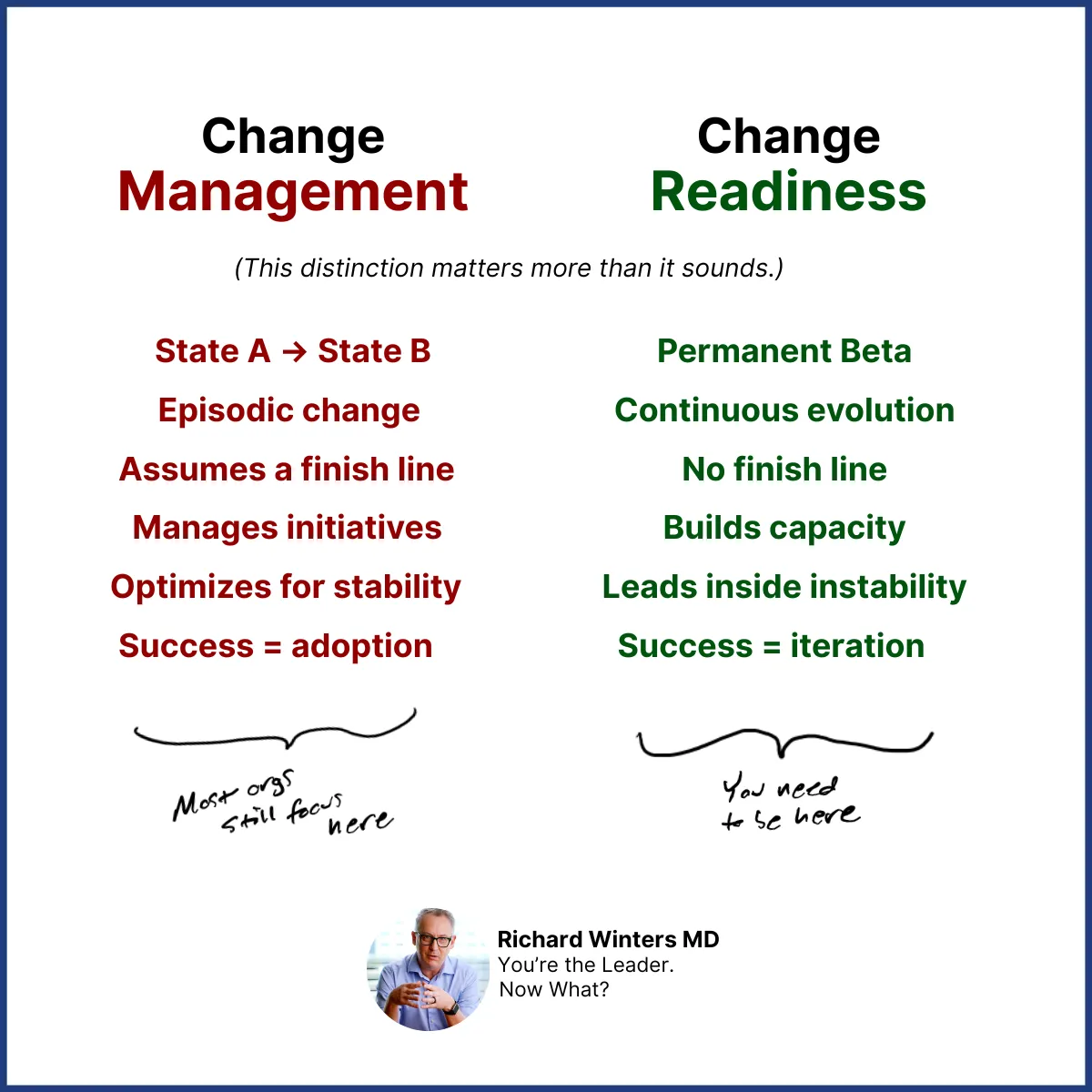
Change management assumes something important: that change ends—and that stability is the default state you return to.
Healthcare has already disproven that, yet much of leadership development still rests on the old assumption.
You’re not moving from state A to state B.
You’re leading inside permanent beta—where yesterday’s rollout becomes today’s baseline and tomorrow’s constraint.
Before the last rollout stabilizes, the next one arrives:
- a new tool,
- a new model,
- a new expectation,
- a new constraint.
This isn’t a temporary surge. It’s the operating environment.
So when we say “manage this change initiative,” what we often mean is:
act as if the ground will eventually stop moving.
It won’t. And pretending it will is how organizations exhaust people while calling it progress.
From managing change to building capacity
Running a change initiative well is not the same thing as building the capacity to lead through the next one—or keeping performance from leaking between initiatives.
That distinction matters.
Change management focuses on execution: timelines, adoption, compliance.
Adaptive capacity focuses on judgment: prioritization, sense-making, tradeoffs, and course correction when conditions keep shifting.
If leaders are only developed to implement projects, they will always lag the environment they’re meant to lead—and default to throughput when the real need is discernment.
You have to see the system, not just your role
Future-ready healthcare leaders can’t operate solely from within their discipline. The hardest problems are cross-boundary problems.
They must understand how the system actually works, not how it’s described in meetings:
- How resources actually get allocated—and who can move them
- How decisions are made under pressure, not on paper
- How incentives shape behavior, especially the behavior you don’t want
- How work moves—or stalls—across departments and roles
Without this systems view, strong leaders optimize locally and create downstream problems they then have to “manage.”
Execution looks solid.
The system stays the same.
Technology doesn’t remove judgment. It raises the bar for it.
AI exposes this gap quickly.
Defensive postures around AI often sound thoughtful, but they frequently mask a deeper issue: leaders haven’t been developed to govern technology—so they try to avoid it instead.
The question isn’t whether to use technology.
It’s whether leaders are equipped to govern it—or whether it quietly governs them.
Governance starts with distinctions leaders can name and teach:
- When to lean on technology
- When human judgment is non-negotiable
- When efficiency quietly degrades care, trust, or learning
If you can’t specify those boundaries, you aren’t implementing technology—you’re delegating decisions to it.
When leaders can’t name those distinctions, technology shapes decisions by default and accountability blurs at exactly the wrong time.
Redefining what leadership value really is
When leadership value is defined narrowly—through productivity metrics alone—leaders learn to protect numbers instead of improving care.
Real leadership impact shows up across:
- Outcomes
- Experience
- Team capability
- Organizational learning
Leaders who can see and articulate impact at this level stop defending metrics and start shaping the conditions that produce outcomes.
Effectiveness deepens.
Influence becomes earned, not positional.
There is no finish line
Change management assumes an endpoint. Healthcare doesn’t have one—and leaders feel that mismatch every week.
The work now isn’t preparing leaders for the next initiative, but for continuous leadership inside constant motion, without burning out teams or degrading care.
The real question isn’t how well you manage change. It’s whether you’re building leaders who can keep performance, judgment, and trust intact when nothing settles.
Organizations that keep training leaders for episodic change will keep paying for the same failures—rework, drift, and quiet degradation between rollouts.