Change Response Teams
They collapse the distance between thinking and doing.
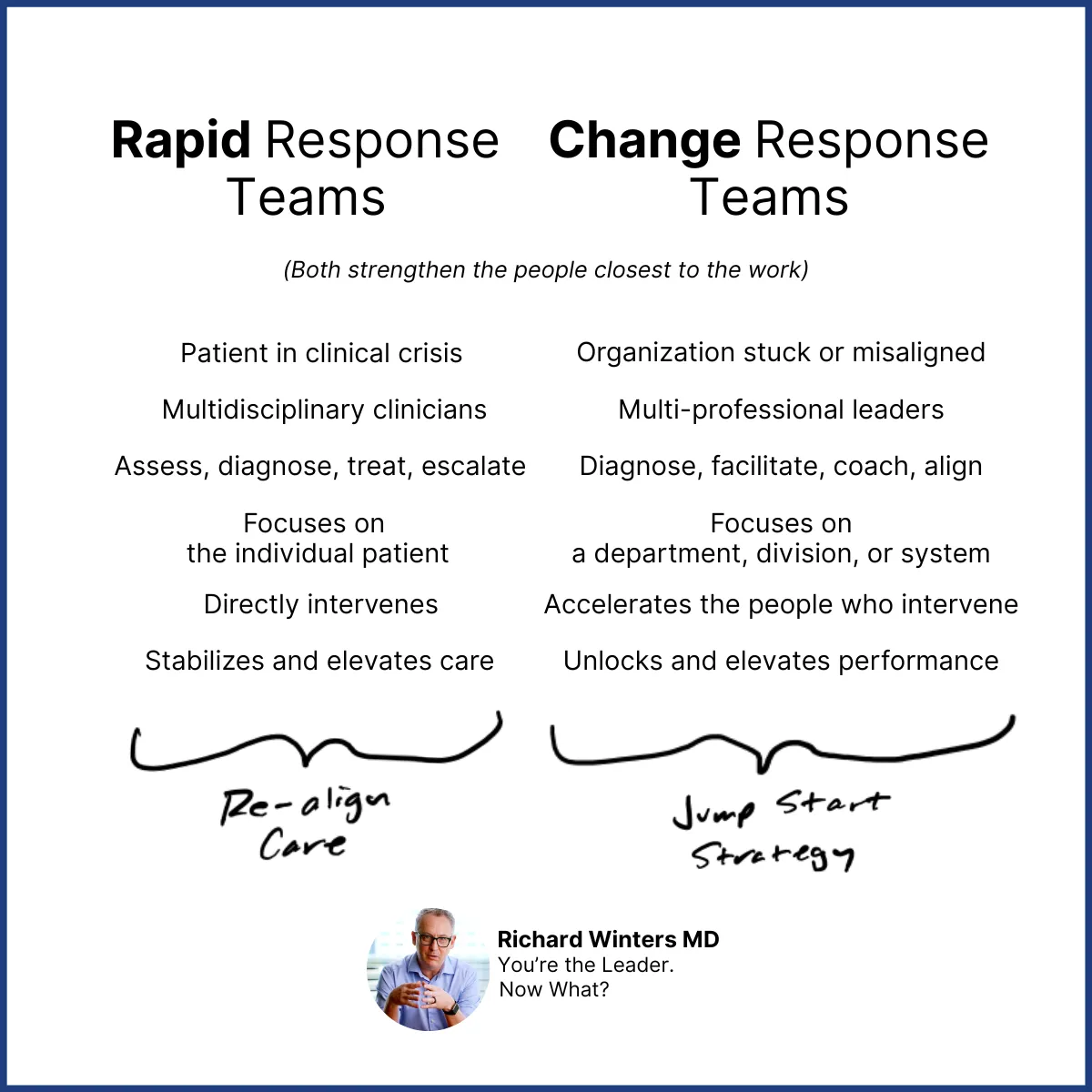
Change Response Teams are Rapid Response Teams—but for strategy.
When a patient deteriorates, we don’t pause to debate ownership. We call a Rapid Response Team to quickly assess, integrate perspectives, act—and escalate if needed.
Change Response Teams serve the same function for organizations.
They enter departments and divisions where progress has stalled or strategy has lost traction. They help leaders diagnose what’s actually happening. They accelerate response when waiting, planning, or re-explaining isn’t enough.
Most healthcare organizations are still built around individual excellence. Strong clinicians. Smart administrators. Capable nurse leaders.
But individual genius doesn’t scale in a system that never stops changing.
Change response doesn’t live in plans or playbooks. It lives in how decisions are made together, in real time.
That’s why Change Response Teams are a form of scenius.
They don’t rely on a heroic leader who “figures it out.” They rely on structures that enable collective sense-making and coordinated action under pressure.
Multi-professional by design. Physicians, nurses, and administrators working as one unit—seeing around each other’s blind spots, integrating clinical reality, operational constraints, and human impact at the same time.
This is the same logic behind dyad and triad leadership models. When decisions are made jointly—rather than sequentially—tradeoffs surface earlier, resistance shows up as information, and adaptation happens before rollout, not after failure.
But Change Response Teams aren’t consultants. And they’re not task forces.
They don’t take over decisions.
They accelerate the leaders who own them.
They move in to support department and division leaders, not replace them. They help teams re-align care, unstick strategy, and move forward together.
Sometimes that’s a unit struggling with throughput or turnover. Sometimes it’s a cross-organizational strategy no single leader can advance alone.
Either way, their quiet advantage is the same: They collapse the distance between thinking and doing.
Instead of: Leadership decides → Teams react → Workarounds emerge
You get: Leaders think together → Teams respond together → Systems adapt together
In a healthcare system operating in permanent beta, response beats readiness. Collective judgment beats individual brilliance. Design beats intention.
If your organization is investing in change management tools, but not in its ability to respond when strategy stalls, you’re strengthening execution in a system that can’t move fast enough.
Change response isn’t a mindset. It’s a design choice.
So ask yourself: What current decision is meeting unexpected resistance— and how might a Change Response Team help you move it forward?