Why Quality Projects Fail
Quality improves processes. Leadership determines whether those processes ever take root.
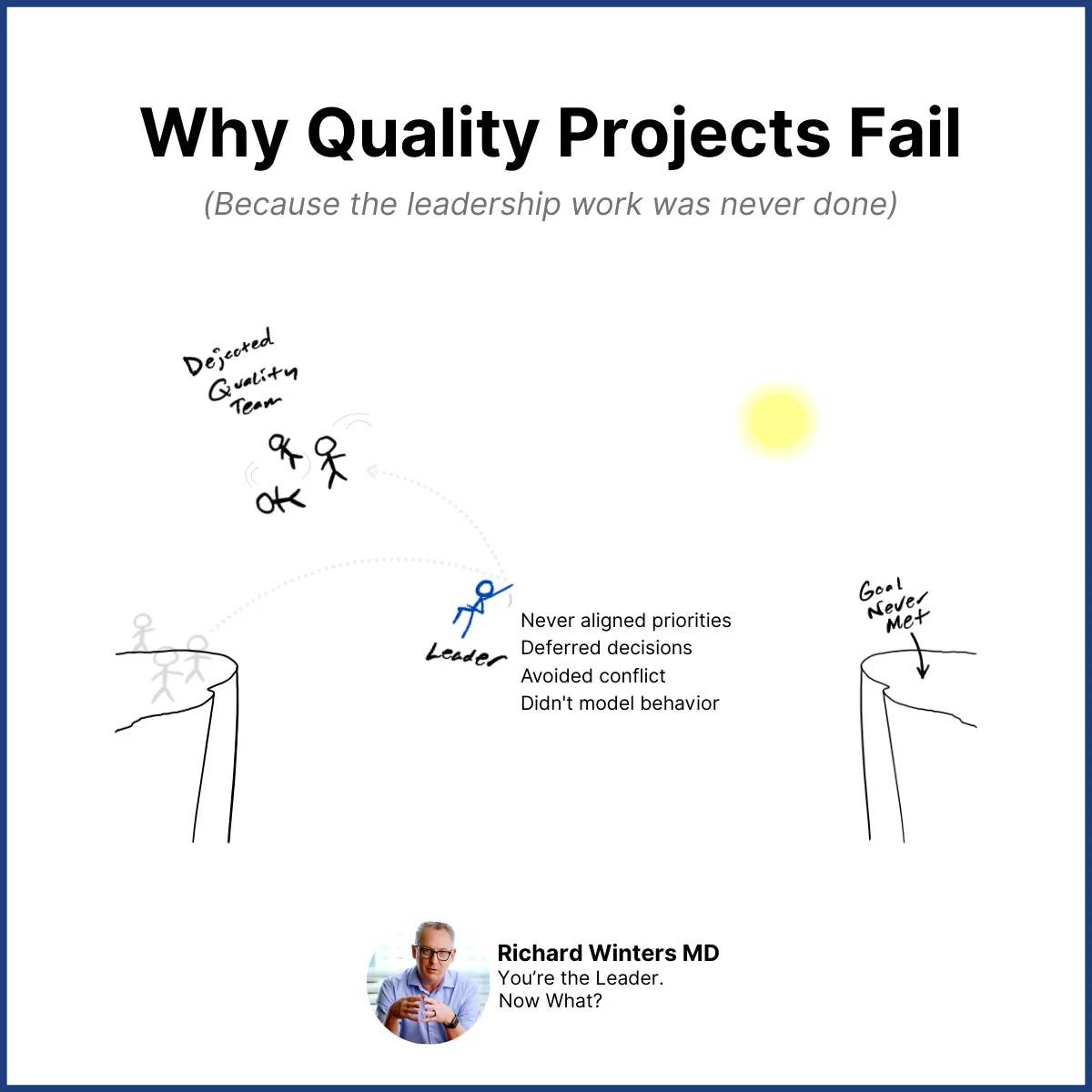
Quality projects rarely fail because the data are wrong or the process map is incomplete.
They fail because leadership realities were ignored.
Here’s the pattern I see over and over:
A quality team does solid work. Clear metrics. Clean workflows. Thoughtful education. The rollout is technically sound.
And then it stalls.
Not because people don’t “get it.” But because leaders aren’t aligned. Because decisions still get made the old way. Because departments are protecting local priorities. Because no one has clarified who has authority to make tradeoffs.
A quality-only approach works beautifully—if four things are already true. They rarely are.
- Agreement already exists
- Decision-making is clear
- Incentives are aligned
- Leaders will behave consistently once the plan is launched
Those are leadership assumptions—not quality ones.
When those assumptions aren’t true, quality teams end up:
- Trying to drive adoption without authority
- Treating political or relational issues as “resistance”
- Adding more education when the real gap is alignment
- Owning outcomes they don’t control
That’s not a capability problem. It’s a design problem.
Strong change initiatives add a leadership layer before implementation:
- Explicit alignment on priorities and tradeoffs
- Clear decision rights across departments
- Agreement on how conflict will be handled
- Leaders modeling the behaviors the change requires
When leadership work is done upstream, quality tools work better downstream. When it’s skipped, quality teams are asked to compensate for leadership gaps they cannot fix.
Quality improves processes. Leadership determines whether those processes ever take root.
If your quality projects keep “mysteriously” breaking down, the problem may not be execution.
It may be that leadership work was never done.
What leadership conversation does your next quality initiative need—before it launches?